
Documentation of mining-related resettlement in the "Archive of Vanished Places" Horno

Documentation of mining-related resettlement in the "Archive of Vanished Places" Horno

The Archive of Vanished Places documents the history of those 137 places in Lusatia that had to make way for open-cast mines, either completely or in part. The exhibition presents the multi-layered and complex topic of "Resettlement in Lusatia" in five central multimedia areas: "Introduction", "Resettlement", "Sorbs / Wends", "Sorbian / Wendish Language Laboratory" and "Battle for Horno".

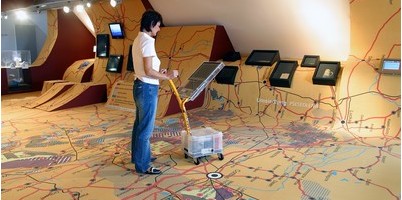
A special attraction is the walk-on map carpet on which all 137 dredged sites in Lusatia can be navigated to using mobile, interactive readers (info suckers). Visitors to the exhibition are asked questions about the exhibition topics, and with navigation aids they can find the answers in the multimedia stations and info suckers.

The offer takes place indoors and is aimed at schoolchildren.
Grades 5 to 12 (approx. 11 to 18 years)
Dates: by arrangement
Pre-registration: 3 days before at the latest
Duration: at least 1 hr.
Group size: up to 15 people
Admission per person: € 0.50
Archive of Vanished Places Horno


Archive of Vanished Places / Archiw zgubjonych jsow

GalleryExhibitions | Offers for children1

Documentation and exhibition centre and agricultural history collection

The archive of vanished places is moving !

IMPORTANT NOTE:
After 18 years, the permanent exhibition "Documentation of Mining-Relocations" in the Archive of Vanished Places is leaving its previous location and will become part of the new exhibition at the Brandenburg Textile Museum Forst (Lausitz).
The exhibition will be permanently closed from 14 September 2024.
Further information about the new museum can be found at: www.forst-lausitz.de

Building / plot situation

The Documentation Centre found its home at the resettlement site of Forst-Eulo in the newly built community centre of today's Forst district of Horno. It was opened on 14 October 2006.
The converted farm barn houses an agricultural history collection.

Characteristics

In connection with the resettlement of the village of Horno to Forst (Lusatia), the idea arose to establish a central information centre that would scientifically document the history of those 137 places in Lusatia and their inhabitants that had to make way for open-cast mining in whole or in part since 1922 (over 25,000 people lost their homes during this period).

In a modern, multimedia presentation, topics such as the history of the Lusatian lignite mining area, the history and present of site demolitions, the effects of resettlement from a socio-cultural and ethnological point of view (Lusatia as a historical settlement area of the Sorbs / Wends) are conveyed. Also documented is the conflict in the process of resettling the community of Horno.

The centrepiece of the exhibition is a walk-through map in the form of a carpet that shows the entire Lusatian mining area. Visitors can use an interactive "Infosauger" to digitally navigate to all the disappeared places.


December 2025
MTWTFSS
1 2 3 4 5 6 7
8 9 10 11 12 13 14
15 16 17 18 19 20 21
22 23 24 25 26 27 28
29 30 31     
" Nov   Jan "

kobi