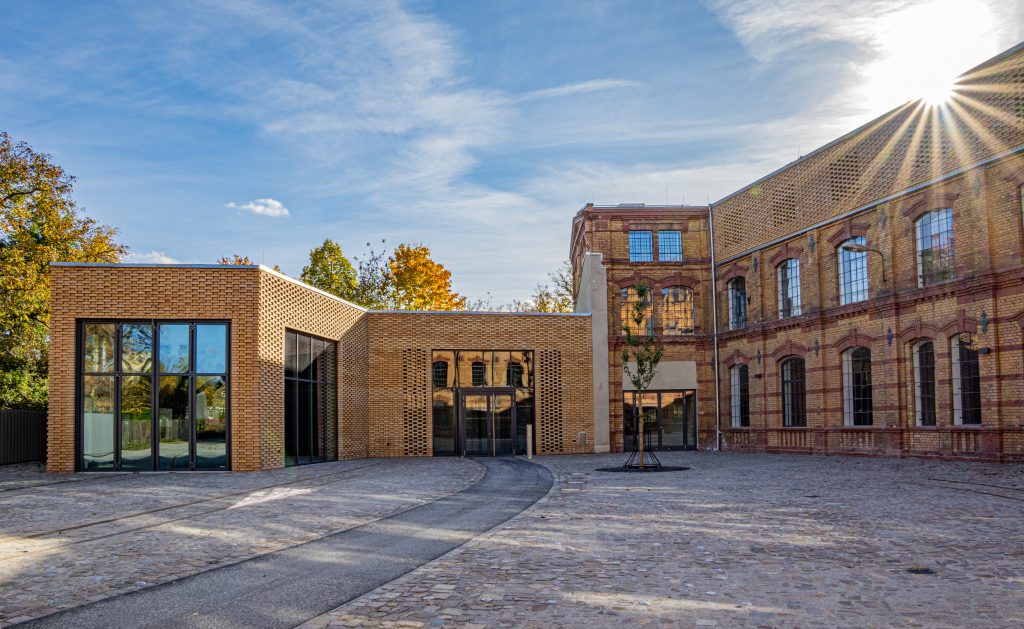
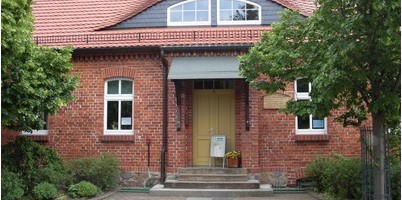
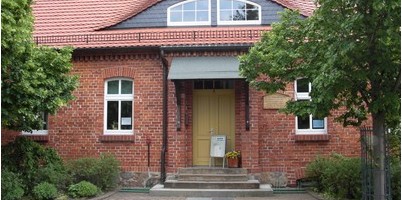
The Brandenburg Textile Museum in Forst (Lausitz) is housed in the building of Daniel Noack's cloth factory, which was built in 1897.
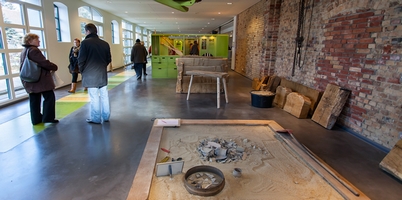
The show workshop, designed as a permanent exhibition, is located in a large factory hall of approx. 500 m² on the ground floor of the building, which was renovated inside and out from 1994 to 1997.
The Brandenburg Textile Museum in Forst (Lausitz) is the only one of its kind in Brandenburg. It is important locally, regionally, statewide and even beyond the state and federal borders. The focus of the museum is on technology, but also on the history of industrial textile production in the town of Forst (Lausitz) from the end of the 19th century to around the middle of the 20th century.
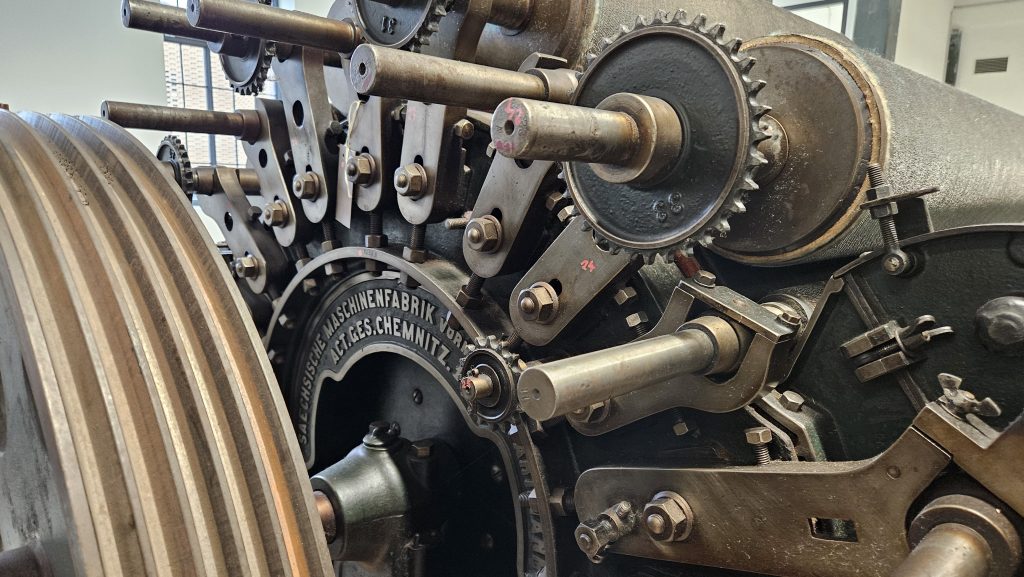
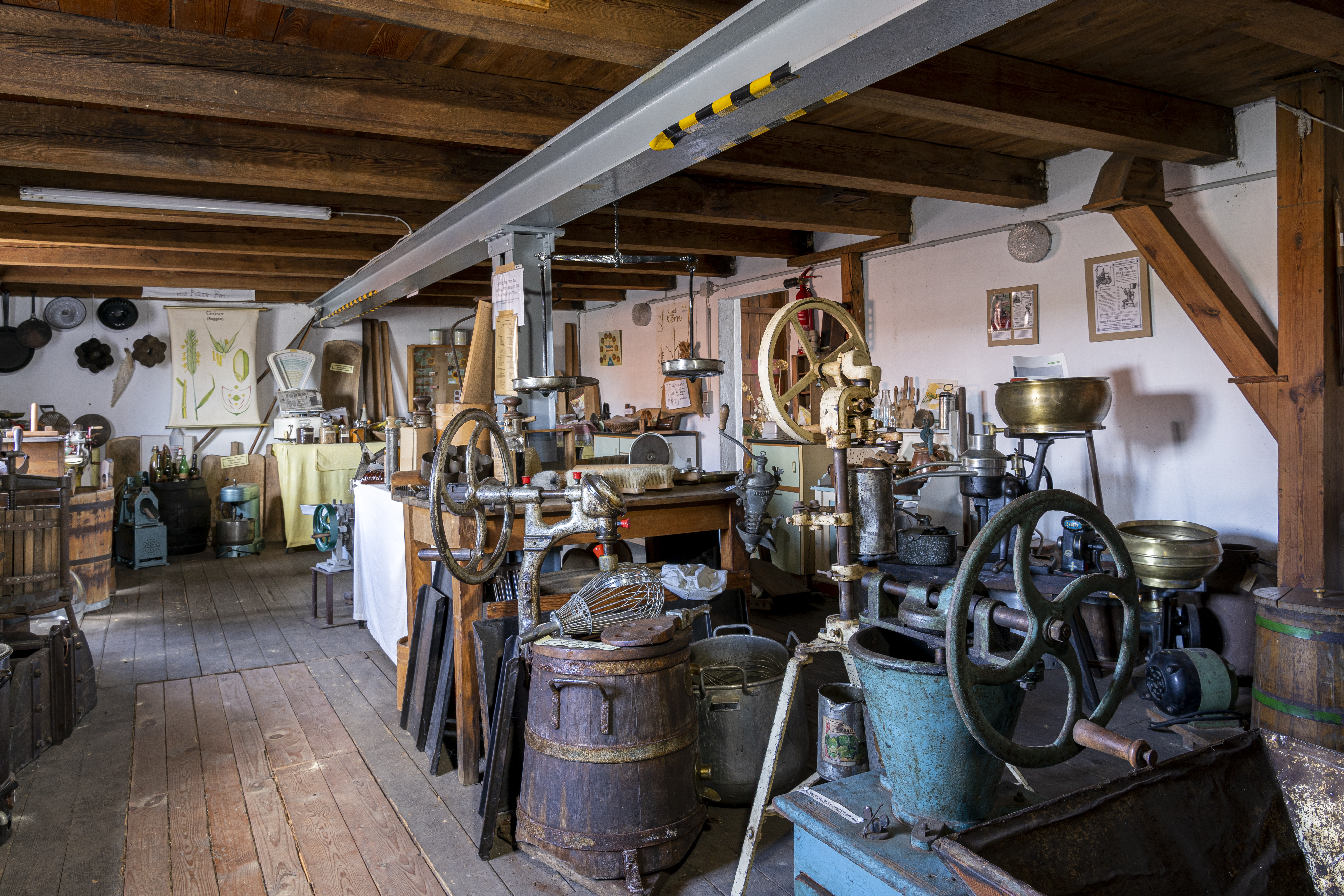
Currently, a clothmaker's show workshop with machinery dating from 1900 to 1950 is the dominant focus of the presentation. In the show workshop, the entire manual and mechanical process of cloth production from spinning, winding and warping to weaving is explained and demonstrated. Visitors learn interesting facts about the working and living conditions in a textile factory. After the tour, guests can try out individual operations for themselves.
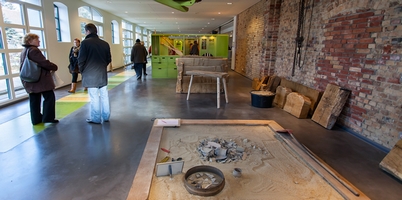
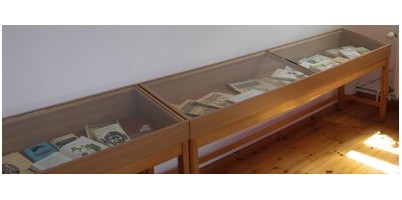
On average, four special exhibitions are shown annually on the first floor (approx. 250 sqm). These are not thematically linked to textile history, but deal with art, photography, city history and cultural history. The special exhibitions are accompanied by author readings and lectures, among other things.
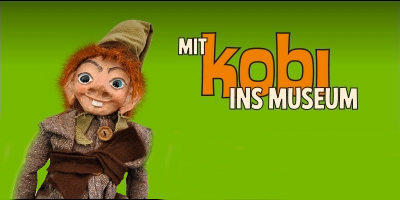
Kobi - the little house ghost - is at home in the museum. He lives there in a slipper under the stove. At midnight, he eavesdrops on the old museum pieces when they tell stories about the past. He tells these exciting stories to the museum staff, who then pass them on to the children - stories from the old, old days.
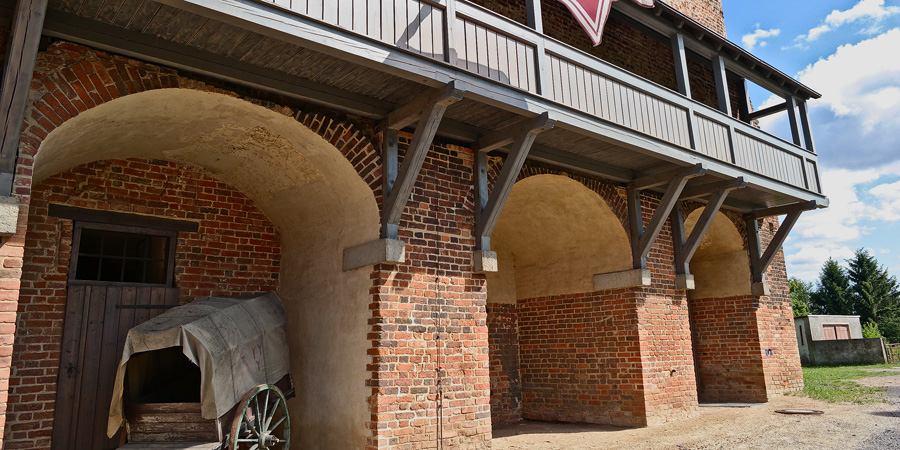
The visitors learn a lot of interesting facts about the history and functioning of the Forster water tower. The water supply in former times and today is shown in short forays. A tour of the water tower can be arranged on request.
Action: Re-creation of the water tower on the handloom frame.
The programme takes place indoors and outdoors and is aimed at pupils in grades 1 to 6.
Dates: by arrangement
Pre-registration at least 1 week in advance
Duration: approx. 3 to 4 hours
Group size: 5 to 20 people
Admission per person: € 3.50
Brandenburg Textile Museum Forst
2. "Schwarze Jule" - Forster city railway
The history of the Forster city railway can be experienced in the museum in pictures and words. Visitors will learn interesting facts from the first journey in 1893 to the last journey in 1965. Many questions will be answered. Why was the town railway built? Who benefited from this railway? What did it transport? Why was it ousted from the cityscape and from the transport system?
Action: Slide - lecture, playful activity in the replica of the "Black Owl" (handicraft sheet/paper)
The offer takes place indoors and is aimed at schoolchildren.
of classes 2 to 5.
Dates: by arrangement
Pre-registration: at least 1 week in advance
Duration: approx. 1.5 to 2 hours
Group size: 5 to 30 people
Admission per person: € 3.50
Brandenburg Textile Museum Forst
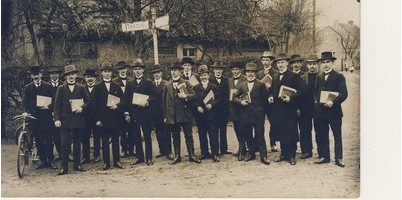
3. city tour and city rally
For once, the children experience our home town of Forst (Lausitz) very attentively, walk through old streets and learn a lot about the history of the once so vibrant textile town. Why do some streets still have small railway tracks today? The children have the opportunity to go on a search for clues. They are given interesting clues to specific buildings or facilities they are looking for. With this information, they can find the building they are looking for - and to finally solve the riddle, they take a photo of it.
In addition, we can organise the crypt (€1.00) and/or an ascent to the tower (€2.50) in the Stadtkirche. These costs are then payable to the Stadtkirche.
The offer takes place indoors and outdoors and is aimed at schoolchildren.
of classes 3 to 6.
Dates: by arrangement
Advance booking: at least 1 week in advance
Duration: approx. 2 to 2.5 hours
Group size: 5 to 30 people
Admission per person: € 3.50
Brandenburg Textile Museum Forst
4. how school used to be
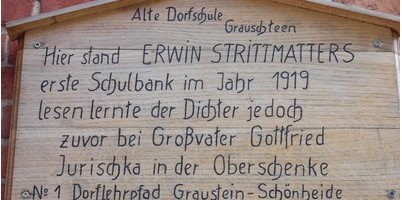
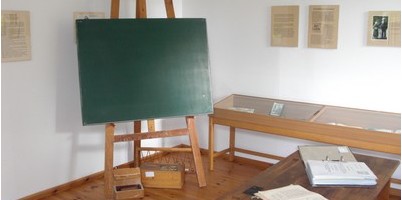
The pupils gain an insight into the development of the school in the town of Forst (Lausitz). They see and hear about the first school building, the first subjects taught and strict teachers. Stories and reports from school life as well as writing with the goose quill and ink enrich this programme.
Action: Sitting on an old school bench, writing the Old German alphabet, cane for rehearsal
The offer takes place indoors and is aimed at schoolchildren.
of classes 3 to 6.
Dates: by arrangement
Pre-registration: at least 1 week in advance
Duration: approx. 2 to 3 hours
Group size: 5 to 30 people
Admission per person: € 3.50
Brandenburg Textile Museum Forst
5. robber baron Nickel von Rothe
Nickel von Rothe, a knight for the poor peasants? Or a robber baron who was persecuted and put out of business? The legendary Nickel von Rothe lived in Mückenhain near Forst at the end of the Middle Ages and wreaked havoc in the surrounding area. Interested visitors can see and hear this story in the museum.
Activity: Slide show with historical saga, knights making jumping jacks
The offer takes place indoors and is aimed at schoolchildren.
of classes 1 to 3.
Dates: by arrangement
Pre-registration: at least 1 week in advance
Duration: approx. 1.5 hours
Group size: 5 to 30 people
Admission per person: € 3.50
Brandenburg Textile Museum Forst
6. floods and their consequences
The pupils learn interesting facts about the flood disasters in and around Forst in words and pictures. A booklet explains various terms related to floods. From historical newspaper reports, the pupils hear about the night of the catastrophe in 1897. The effects of the flood waves of a flood are simulated on a model that shows the surface of the earth in cross-section.
Activity: Work with the accompanying booklet, observe the process in the flood model, build a sandbag wall
The offer takes place indoors and outdoors and is aimed at schoolchildren.
of classes 3 to 6.
Dates: by arrangement
Pre-registration: at least 1 week in advance
Duration: approx. 2 hours
Group size: 5 to 30 people
Admission per person: € 3.50
Brandenburg Textile Museum Forst
7. the Bieberstein coat of arms and the Forster coat of arms
In this programme, the pupils learn interesting facts about naming and heraldry. Many names, such as Meier, Schulze and Lehmann, used to have coats of arms. The Lords of Bieberstein also had various coats of arms. The coat of arms of the town of Forst has evolved from the large Bieberstein coat of arms. What it looks like, what shape and colour it has, is taught to the pupils in this programme.
Activity: Worksheets with coats of arms for colourful design
The offer takes place indoors and is aimed at schoolchildren.
of classes 3 to 6.
Dates: by arrangement
Pre-registration: at least 1 week in advance
Duration: approx. 1 to 1.5 hours
Group size: 5 to 30 people
Admission per person: € 3.50
Brandenburg Textile Museum Forst
8. industrialisation
Many empty factories and the railway tracks of the "Black Jules" tell of the once vibrant "German Manchester". There are reports about personalities who helped Forst to industrial growth and prestige. What conditions were necessary for the operation of mechanical machines? What is the connection between industrial development in Forst and the living conditions of employees and employers? How are yarn and cloth made today? We will explore many questions together and find answers.
Activity: Work with video clips, old address books and chronicles, recording technical data of the machines in the clothmaker's show workshop and city tour
The offer takes place indoors and outdoors and is aimed at schoolchildren.
of grades 8 to 10.
Dates: by arrangement
Pre-registration: at least 1 week in advance
Duration: approx. 3 hours
Group size: 5 to 30 people
Admission per person: € 3.50
Brandenburg Textile Museum Forst
9. sew a cosy patchwork cushion yourself
Patchwork - this artistically appealing textile work literally means "patchwork". This creative technique was first used in ancient Egypt, more than 2000 years ago. For thousands of years, people all over the world have puzzled pieces of fabric together out of necessity or for fun and then sewn them together to make a "new fabric" again. Ingenuity, different materials and cultural differences have resulted in a multitude of different patterns and patchwork techniques.
Action: Sewing a patchwork cushion
The offer takes place indoors and is aimed at schoolchildren.
of classes 6 to 10.
Dates: by arrangement
Pre-registration: at least 1 week in advance
Duration: approx. 1 to 1.5 hours
Group size: 5 to 30 people
Admission per person: € 3.50
Brandenburg Textile Museum Forst
10. thread pictures
In the clothmaker's show workshop, the pupils experience the work steps that are necessary to produce a thread. The demonstrations are shown on the historical hand tools and the machines from the 20th century. The hand-operated and machine processes are demonstrated on the spinning wheel, winding wheel, sample carding machine, selfactor and ring spinning machine and explained by the specialist staff. In a subsequent practical activity, the visitors make a work of thread art from many colourful threads on a stenter frame.
The offer takes place indoors and is aimed at schoolchildren.
of classes 3 to 6.
Dates: by arrangement
Pre-registration: at least 1 week in advance
Duration: approx. 1.5 hours
Group size: 5 to 30 people
Admission per person: € 3.50
Brandenburg Textile Museum Forst
11. felting with sheep's wool
On a tour of the clothmaker's workshop, pupils learn how sheep's wool is processed. Pupils can try out wet or dry felting and make their own accessories for the home.
The offer takes place indoors and is aimed at schoolchildren.
of classes 3 to 6.
Dates: by arrangement
Pre-registration: at least 1 week in advance
Duration: approx. 2 hours
Group size: 5 to 30 people
Admission per person: € 3.50
Brandenburg Textile Museum Forst
12. fabric hearts
In the clothmaker's workshop, the pupils learn how cloth is made. They see and hear how work was done on the historical hand tools and machines. In particular, they can follow the technical development from the hand loom to the mechanical loom. Furthermore, the visitors learn a lot of interesting facts about the historical development of the handicraft technique "patchwork" in a short introduction. Patchwork" means "patchwork" in translation. The pupils work in the simple patchwork gluing technique. They put the differently coloured patterned pieces of fabric together and join them by gluing and sewing.
The offer takes place indoors and is aimed at schoolchildren.
of classes 3 to 6.
Dates: by arrangement
Pre-registration: at least 1 week in advance
Duration: approx. 2 hours
Group size: 5 to 30 people
Admission per person: € 3.50
Brandenburg Textile Museum Forst
13. flower magic from fabric scraps
In the clothmaker's workshop, the pupils learn how cloth or fabric is made. They see and hear how work was done on the historical hand tools and machines. Among other things, they can follow the technical development from the spinning wheel to the spinning machine. In this museum educational programme, the pupils work with coloured fabric remnants made of cotton or synthetics. They can choose the colours freely according to their sensibilities. Creating a jewellery ball is purely a handicraft and requires a little more time and perseverance.
(Use as room or window decoration, suitable for the seasons and for Christmas time)
In the clothmaker's workshop, the pupils learn how cloth or fabric is made. They see and hear how work was done on the historical hand tools and machines. Among other things, they can follow the technical development from the spinning wheel to the spinning machine. In this museum educational programme, the pupils work with coloured fabric remnants made of cotton or synthetics. They can choose the colours freely according to their sensibilities. Creating a jewellery ball is purely a handicraft and requires a little more time and perseverance.
(Use as room or window decoration, suitable for the seasons and for Christmas time)
The offer takes place indoors and is aimed at schoolchildren.
of classes 4 to 6.
Dates: by arrangement
Pre-registration: at least 1 week in advance
Duration: approx. 2 to 2.5 hours
Group size: 5 to 30 people
Admission per person: € 3.50
Brandenburg Textile Museum Forst
14. thin threads become a strong cord
The pupils are given a special demonstration on the braiding machine in the clothmaker's show workshop. They observe how this machine creates a firm, braided cord through fast rotating movements around its own axis and through tense, pulling movements. With these made cords, the pupils can make simple or more sophisticated jewellery elements. Old handicraft techniques, such as braiding with ribbons or knotting in simple steps, are offered as practical work.
The offer takes place indoors and is aimed at schoolchildren.
of classes 3 to 6.
Dates: by arrangement
Pre-registration: at least 1 week in advance
Duration: approx. 1-1.5 hours
Group size: 5 to 30 people
Admission per person: € 3.50
Brandenburg Textile Museum Forst
15. a woven cloth becomes a doily
The historical exhibition includes the hand spinning wheel, the hand winding wheel, the warping frame and the hand loom. The pupils see and hear how work was done on the historical hand tools. In this area they can still grasp the making of the thread and the weaving of a cloth with the naked eye. Each pupil receives a woven piece of cloth. By pulling out individual threads from the edge of the cloth, fringes are created which form the outside of the doily. More threads can be pulled out of the inner part of the doily. This creates a decorative pattern in the doily.
The programme takes place indoors and is aimed at 5 to 7-year-olds or pupils up to grade 2.
Dates: by arrangement
Pre-registration: at least 1 week in advance
Duration: approx. 1 hour
Group size: 5 to 30 people
Admission per person: € 3.50
Brandenburg Textile Museum Forst
16. napkin technique
The pupils are given a guided tour of the clothmaker's workshop on the topic "From wool to cloth". They learn a lot of interesting facts about the historical machines that are necessary to process the wool in order to make a cloth.
The offer takes place indoors and is aimed at schoolchildren.
of classes 3 to 6.
Dates: by arrangement
Pre-registration at least 1 week in advance
Duration: approx. 1 to 1.5 hours
Group size: 5 to 30 people
Admission per person: € 3.50
Brandenburg Textile Museum Forst
How was washing done in the past?
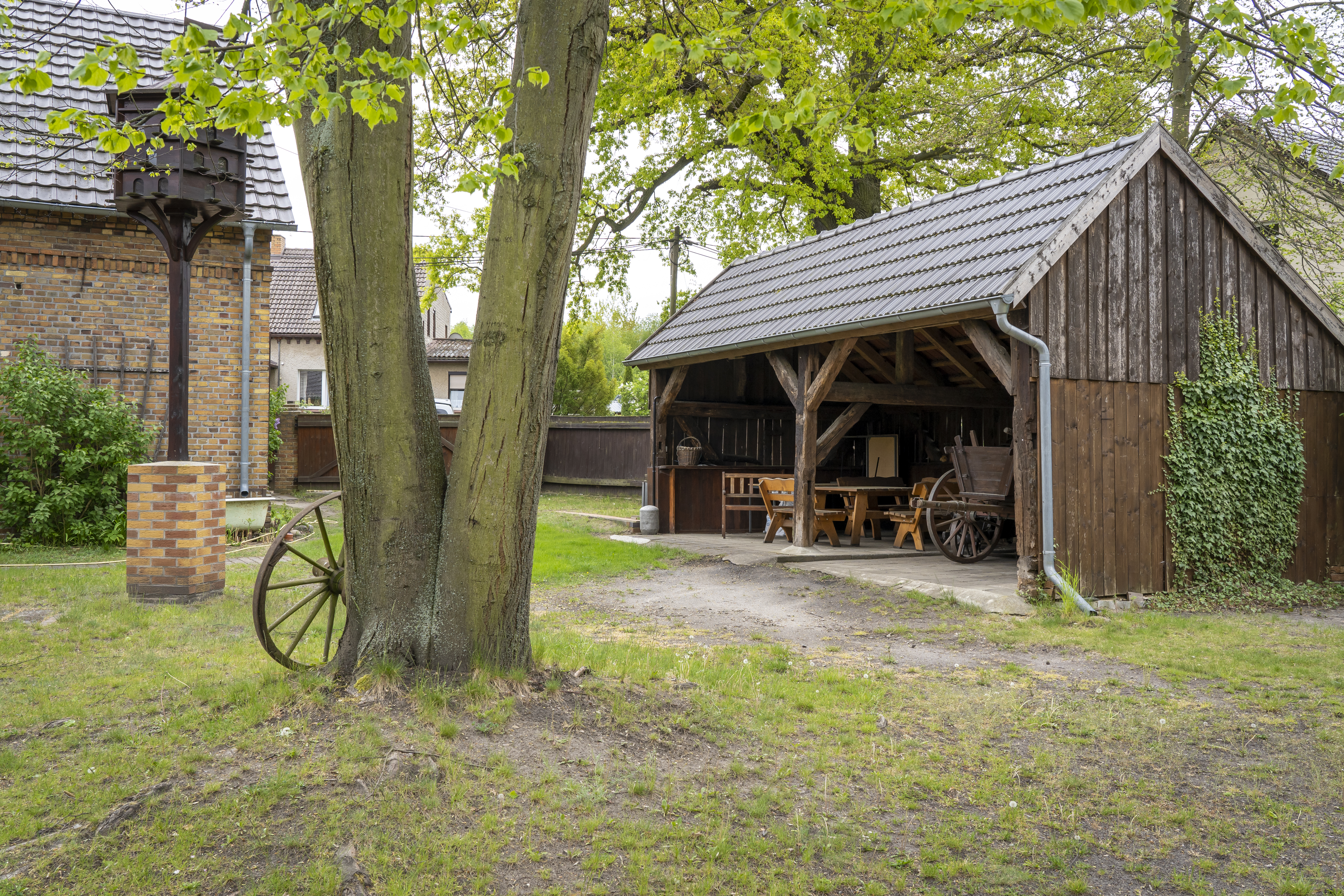
In the museum courtyard, the pupils visit the open-air exhibition on the subject of "Washing clothes". Afterwards, they can try out for themselves how laborious washing was for women in the past. The focus is on washing on the washboard, hanging up laundry and rolling laundry with a hand roller.
Hint:
Laundry items, such as your own socks and tea towels, are particularly good for working with.
The programme takes place indoors and outdoors and is aimed at pupils in grades 2 to 6.
Dates: by arrangement
Pre-registration: at least 1 week in advance
Duration: approx. 2.5 to 3 hours
Group size: 10 to 30 people
Admission per person: € 3.50
Brandenburg Textile Museum Forst
18. we make our own paper
People have been leaving messages or making records for a long time. Early humans painted the walls of their caves, the Egyptians wrote their hieroglyphics on papyrus, the Romans on wax tablets, and in the Middle Ages monks used parchment made from animal skin. The pupils learn a lot of interesting facts about the history and production of paper and how they can make it themselves.
Action: Making paper
The offer takes place indoors and is aimed at schoolchildren.
of classes 3 to 8.
Dates: by arrangement
Pre-registration: at least 1 week in advance
Duration: approx. 2 to 2.5 hours
Group size: 10 to 30 people
Admission per person: € 3.50
Brandenburg Textile Museum Forst
19. how the mole got a pair of trousers
The picture book story about Pauli the mole, who wants a pair of trousers with big pockets, is read. The children hear and see many different animals in the story. Each animal masters a different craft. For example, the spiders, they spin the threads for Paul the mole to weave the trousers. The industrious ants hammer, saw and carpenter the loom. The cloth is woven on the loom. Pauli the mole and many animals manage to make the trousers with the big pockets by working together. In the clothmaker's show workshop, the children experience the making of a cloth during a demonstration of the machines.
Action: Dressing the mole figure
The offer takes place indoors and is aimed at schoolchildren.
of classes 1 to 2.
Dates: by arrangement
Pre-registration: at least 1 week in advance
Duration: approx. 1.5 hours
Group size: 5 to 30 people
Admission per person: € 3.50
Brandenburg Textile Museum Forst
20. weaving on the handloom frame
In the clothmaker's workshop, visitors learn how cloth is made. They see and hear how work was done on the historical hand tools and machines. In particular, visitors can follow the technical development from the hand loom to the mechanical loom. In the subsequent practical activity, the pupils practise weaving on the handloom frame. The richly coloured yarns and various effect yarns used as weft create unique artistic pieces.
The offer takes place indoors and is aimed at schoolchildren.
of classes 3 to 7.
Dates: by arrangement
Pre-registration: at least 1 week in advance
Duration: approx. 2 to 2.5 hours
Group size: 5 to 30 people
Admission per person: € 3.50
Brandenburg Textile Museum Forst












 Deutsch
  English (UK)
  Polski
  Čeština
  Serbski